Its role in the 'fight & flight' response
Structure
As the name suggests, suprarenal glands are located on top of both kidneys.
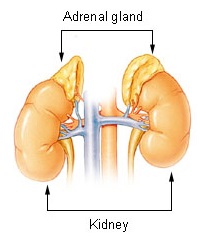
Surrounding the gland is a protective capsule, and beneath this is a layer of
fatty tissue. These tissues do not contribute to the functioning of the
gland.
Blood supply
As the suprarenal gland can be critically important in survival, blood supply is extensive. There are three arteries which supply the suprarenal gland, all of which branch off different blood vessels. These are;
· The superior suprarenal artery, which branches off the interior phrenic artery
· The middle suprarenal artery, which branches off the abdominal aorta
· The inferior suprarenal artery, which branches off the renal artery
The suprarenal gland has the greatest mass of vasculature per gram of any organ in the human body, this is necessary for the correct functioning of this organ. By having such high levels of blood supply the suprarenal gland is able to quickly secrete large quantities of the hormones it produces into the blood. As well as this, having three arteries providing blood means that occlusion is less likely to effect the action of the gland. Blood is drained from the suprarenal gland by the right and left suprarenal veins, which feed into the inferior vena cava and left renal veins respectively.
Cortex
The outer layer of the suprarenal gland is the cortex; this can be divided into three layers:
o Zona Glomerulosa
o Zona Fasciculata
o Zona Reticularis
These three layers are structurally and functionally different from one another.
The Zona Glomerulosa produces and secretes the Aldesterone.
The Zona Fasciculata and Zona Reticularis produce both Cortisol and androgens.
The cortex makes up approximately 90% of the mass of the suprarenal gland. The thickest layer of the cortex is the Zona Fasiculata which makes up roughly 80% of the thickness. After this the next greatest layer is the Zona Glomerulosa making up around 15% of the thickness of the cortex, whereas the Zona Reticularis is just over 5%.
Medulla
The inner most layer of the suprarenal gland is called the medulla. This constitutes the remaining 10% of the mass of the suprarenal gland. This structure is exclusively responsible for all of the production of adrenalin (epinephrin) in the body as well as contributing to the production of noradrenalin (norepinephrin).
Image courtesy of wikicommons found under the creative commons licence